




- Website -







 Current Location:
NEWS INFORMATION
Yuyuan Steel Structure
Rock Wool Color Steel Sandwich Panel for Fire Safe Insulated Buildings
AUTHOR:yuyuan DATE:2026-10-11 11:13:35 HITS:129
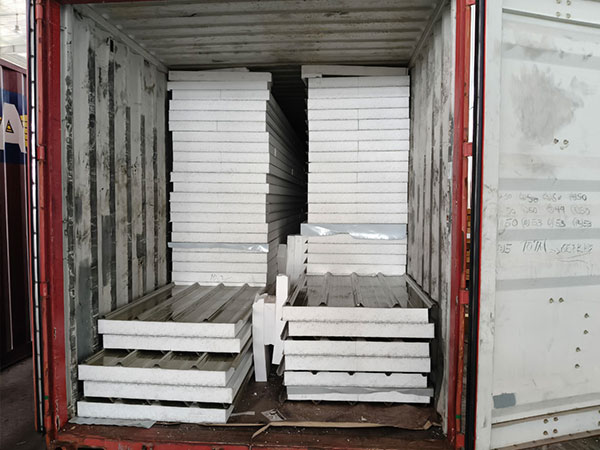
In an industrial building, the cladding is often treated as a finishing item - until a fire, a condensation problem or an energy bill proves otherwise. The rock wool color steel sandwich panel has become the default specification wherever fire safety, thermal stability and acoustic control all matter, because its mineral core is non-combustible in a way polymer foams simply are not.

Understanding the differences between rock wool, EPS and PU cores lets a buyer spend money where it counts. A cold store, a food factory and a simple storage shed do not need the same panel, and over-specifying is as wasteful as under-specifying.
What a Color Steel Sandwich Panel Is
A sandwich panel is a composite: two pre-coated steel faces bonded under continuous pressure to an insulating core. The faces carry bending stress and provide weather resistance; the core delivers thermal insulation, rigidity and - critically - fire behaviour. Panel thickness commonly ranges from 50 mm to 150 mm, with steel face thickness 0.4-0.6 mm.
Faces: galvanized, pre-painted steel with PE, SMP or PVDF coating; stainless or aluminium faces available for food-grade and corrosive environments.
Core: rock wool (mineral fibre, non-combustible), EPS (expanded polystyrene) or PU/PIR (polyurethane / polyisocyanurate).
Joints: tongue-and-groove or ship-lap with concealed fastening, sealed with butyl or silicone for air and water tightness.
Fire Performance: The Decisive Difference
Rock wool is manufactured from basalt and slag spun into fibre at temperatures above 1,000 °C, and it retains structural integrity at those temperatures. In fire terms it is classified as non-combustible (Euroclass A1 / A2), meaning it does not contribute fuel and does not generate dense toxic smoke. EPS and standard PUR are combustible and, unless specially formulated, can propagate flame along the core once the steel face is breached.
| Property | Rock wool | EPS | PU / PIR |
|---|---|---|---|
| Fire classification | Non-combustible (A1/A2) | Combustible, melts | Combustible, chars |
| Thermal conductivity (W/mK) | 0.038-0.044 | 0.036-0.040 | 0.020-0.024 |
| Density (kg/m3) | 80-150 | 12-20 | 35-45 |
| Acoustic performance | Excellent | Moderate | Moderate |
| Dimensional stability in heat | Excellent | Poor above 80 °C | Fair |
| Relative cost | Higher | Lowest | Medium-high |
| Typical use | Fire-rated zones, factories, cold stores, public buildings | Temporary or low-risk storage | Cold chain, temperature-controlled space |
Thermal and Acoustic Behaviour
PU and PIR cores have the best thermal conductivity per millimetre, which is why cold stores often specify them. Rock wool compensates with a fibrous structure that absorbs sound: a rock wool panel wall routinely delivers 25-35 dB of sound reduction, which matters in workshops, compressor rooms, generator enclosures and buildings close to residential boundaries.
Specification Checklist
Panel thickness and core density matched to the required U-value and fire rating.
Steel face thickness and coating system (PE for standard, PVDF for coastal or high-UV sites).
Joint type and sealant specification for air-tightness and condensation control.
Maximum allowable purlin spacing - thicker panels span further, which can reduce secondary steel.
Accessory package: flashings, ridge caps, corner trims, sealants and fixing screws.
Installation Practices That Protect Performance
Most panel failures are installation failures, not product failures. Panels must be stored dry and flat, lifted with spreader bars, and fixed with the correct screw length and washer type. Joints need continuous sealant beads; cut edges on site must be protected immediately; and thermal bridges at purlins and panel junctions should be minimised to avoid condensation streaking on the internal face.
Frequently Asked Questions
Q: Is rock wool sandwich panel worth the extra cost over EPS?
For any occupied, high-value or fire-regulated building, yes. The cost premium is modest relative to the building value, and insurance, compliance and energy-performance benefits usually outweigh it.
Q: What thickness should I choose?
50-75 mm for general industrial walls and roofs in temperate climates, 100 mm for conditioned or cold-storage buildings, and 150 mm for freezer or high-performance envelopes.
Q: Can panels be used for both roof and wall?
Yes, but roof panels require a deeper profile and adequate purlin support for foot traffic and snow load; always confirm the allowable span with the manufacturer.
Q: Does rock wool absorb water?
Quality rock wool is hydrophobic with low water absorption and is faced on both sides by steel, so moisture ingress only occurs through unsealed cut edges or damaged joints - both avoidable on site.
Q: Can I mix cores in one building?
Common practice: rock wool for fire-rated walls, escape corridors and plant rooms, with PU or EPS roofs elsewhere. Confirm that local codes permit the mixed approach for your occupancy.
Conclusion
The rock wool color steel sandwich panel is the safe, durable choice wherever fire, acoustics and thermal stability are part of the brief. Specified with the right thickness, coating and joint detail, it turns a steel structure building material package into a genuinely high-performance envelope.
Yuyuan Steel Structure manufactures rock wool color steel sandwich panels alongside H steel sections, color steel tiles, C and Z shaped steel and floor decking, so wall, roof and frame arrive as one coordinated package. Get a panel specification and quotation with our engineering team.
References
GB/T 7714: Fire Behaviour of Mineral Wool Cores in Metal-Faced Sandwich Panels. Fire Safety Journal.
MLA: Thermal Bridging and Condensation Risk in Insulated Metal Panel Envelopes. Building and Environment.
APA: Comparative Life-Cycle Assessment of Rock Wool, EPS and PIR Sandwich Panels. Journal of Building Engineering.
-
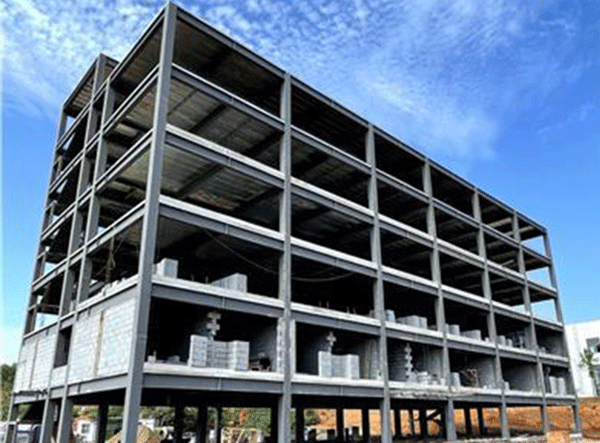
Fast Assembled Multi-Story Steel Structure Workshop Factory For Industrial Use
-
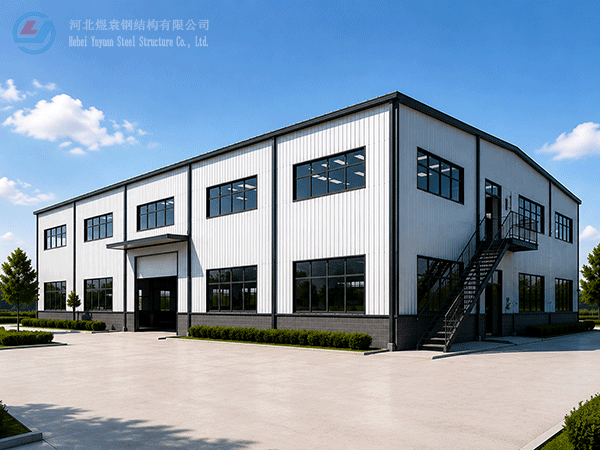
Modern Two-Storey Prefabricated Steel Structure Workshop Building Industrial Shed Construction
-
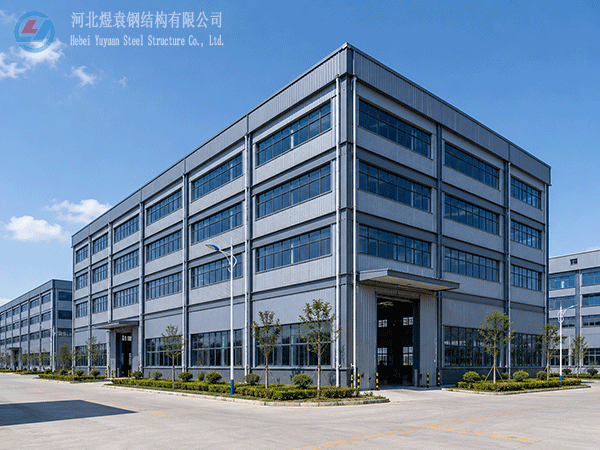
Yuyuan export Steel Structure Warehouse Prefab Steel Structure Warehouse for storage
-

Export steel structure workshops Prefabricated steel structure workshops Light steel structure war
-

High Quality Low Cost Prefabricated Steel Structure Industrial Warehouse Shed
-
Xiao Sheng - Maldives
-
Xiao Sheng - Maldives
-
Xiao Sheng - Maldives
Hebei Yuyuan Steel Structure Co., Ltd.
Copyright © 2024-2025 https://www.yysteelwarehouse.com. All Rights Reserved Hebei Yuyuan Steel Structure Co., Ltd. All Rights Reserved.